THE SWISS H-5
At the beginning of the Swiss Air Force helmet evaluation programme in 1950, the procurement, importation and logistics of all helmets submitted for testing were entrusted to the Zürich-based company Sportex.
Sportex had entered the protective helmet business shortly after the Second World War.
Beginning in 1946, the company imported French motorcycle crash helmets but soon recognised the need for significant improvements. Working in cooperation with the bonnet manufacturer Fürst of Wädenswil, Sportex developed an improved design that rapidly established the company as Switzerland's leading specialist in protective headgear.

During the evaluation programme, the Swiss Air Force also reassessed the eye protection then in service. Pilots were using either the American B-8 or M-1944 flying goggles, but operational experience revealed several shortcomings. Plastic lenses were easily scratched, reducing visibility, while perspiration frequently caused fogging. Conventional sunglasses offered little protection during an emergency ejection. For these reasons, an integrated helmet-mounted visor was considered the most suitable solution.
Among the helmets evaluated, only one of the two P-3 configurations incorporated a visor.
Although technically satisfactory, its visor assembly proved incompatible with Martin-Baker ejection seats. Trials carried out using a borrowed Martin-Baker ejection-seat training rig demonstrated that the upper ejection handle could become trapped in the protruding handgrip of the visor yoke during seat activation, creating an unacceptable safety hazard.


The solution emerged with the introduction of the British Mk.1A "Bone Dome" into the evaluation programme.
Its Mk.2 Anti-Glare Visor had already been designed for compatibility with Martin-Baker ejection seats installed in the de Havilland DH-100 Vampire, DH-112 Venom and DH.115 Vampire Trainer, as well as in the Hawker Hunter, all aircraft either already in Swiss service or scheduled for introduction.
As with the visorless Mk.1 helmet, the Mk.1A formed part of the standard flying equipment issued to British ferry pilots delivering aircraft from the United Kingdom to Switzerland.
In 1954, the Swiss Air Force tasked Sportex with developing a method of installing the British Mk.2 visor assembly on both the P-3 and H-5 helmet.
The project presented a significant engineering challenge. The curvature of the British visor track differed from that of the American helmet shell, preventing direct installation.
Sportex solved the problem by designing a specially shaped spacer that compensated for the difference in radii. The first adapters were handcrafted from lime wood before being replaced by more durable nylon components. Once the prototypes had proven successful, the modified visor assemblies were approved for production.


To adapt the British Mk.2 visor assembly to the H-5 helmet, the visor tracks also required several modifications.
The rear nylon end caps fitted to the original British tracks were removed and relocated to the front of the assembly. In addition, the rear section of each track was shortened to accommodate the Swiss-designed radius adapter.
These apparently minor alterations allowed the British visor system to integrate with the American H-5 shell while maintaining full compatibility with Martin-Baker ejection seats.


The visor slider incorporated a spring-loaded steel ball engaging a series of machined recesses in the visor track. This mechanism securely retained the visor in the selected position while allowing smooth adjustment by the pilot.
Following completion of the evaluation programme, the Swiss Air Force placed an order for 400 H-5 helmets, divided into four sizes:
-
100 Extra Small
-
220 Small
-
70 Medium
-
10 Large
The helmets were delivered to the Sportex facilities, where all modifications were carried out under the supervision of two Swiss Air Force representatives.
Once completed, the helmets were packed in heavy-duty cardboard containers manufactured by Sportex before being delivered to Dübendorf Air Base for storage and subsequent issue to operational units.
The helmet was assigned the designation P.A. (Piloten Ausrüstung – Pilot Equipment) 590, later amended to P.A. 591, under which it remained catalogued until its final withdrawal from service.

The earlier H-5 helmets supplied to the squadrons kept the original U.S. Navy metallic gold; a colour selected because of its excellent ability to reflect solar radiation and minimise heat absorption.
Operational experience, however, demonstrated that white offered even better performance under prolonged exposure to sunlight. Consequently, beginning in 1958, the helmets were progressively repainted white.
The example illustrated below shows a virtually factory fresh, gold-finished USN H-5 complete with all original components but missing the installation of the communications equipment.


The internal energy-absorbing liner evolved through three distinct generations.
The earliest helmets were fitted with a white-yellow foam liner permanently bonded to the shell. Its presence generally identifies helmets belonging to the first production batches supplied to Switzerland.


A second pattern, introduced later, consisted of a green expanded-foam liner divided into three separate sections.
During the early 1970s, this design was replaced by a locally manufactured white liner of identical configuration but slightly reduced thickness, the change was probably prompted by the diminishing availability of imported green replacement liners.
Unlike the early bonded liner, both later versions were simply inserted into the helmet shell without adhesive, allowing rapid replacement during routine maintenance.
In all three configurations, small protective pads made from the same material as the liner were bonded over the rivet heads securing the head sling, preventing pressure points and improving wearer comfort.


The headsling was the same one used on the H-4 helmet hardshell provided by external buckles that allowed the size adjustment of its rear section.


Perhaps the most distinctive modification applied to the Swiss H-5 was the so-called "Gullwing Cut."
Developed to improve the pilot's upper field of vision, the modification consisted of removing portions of the shell around the forehead area, producing the characteristic profile that has become synonymous with Swiss H-5 helmets.
Despite its widespread adoption, not every helmet received the modification. Numerous examples remained in their original configuration throughout their service lives, particularly those assigned to helicopter units, where several unmodified helmets remained in use until the mid-1980s.

A second proposal sought to improve upward head movement by trimming the rear edge of the helmet shell.
Although technically feasible, the proposal was rejected by the Swiss Air Force Medical Institute, which considered that removing material from the rear of the shell would expose the pilot to an unacceptable increase in the risk of head injury during an accident.
Nevertheless, a small number of pilots carried out the modification privately on their own helmets, creating examples that can still occasionally be encountered today.
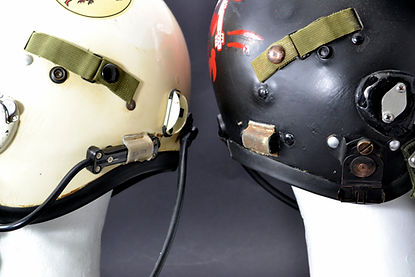
The picture is an example of a not modified (left) and a modified (right) H-5.

During the evaluation phase and throughout its first years of operational service, the H-5 was used with the British H-Type oxygen mask and, alternatively, with the American A-14. Both were later replaced by the more advanced A-13A/MS22001. During some tests and in specific cases, it was also equipped with an MBU-5/P.

H-Type.

A-14.

MS22001 Diluter Demand.

MS22001 Pressure Demand.

MBU-5.
Both the H-Type and the A-14 were diluter-demand oxygen systems. Although entirely adequate for the operational requirements of the early jet era, their design imposed a practical ceiling of approximately 10,000 metres, beyond which they no longer provided sufficient physiological protection.
The introduction of the A-13A/MS22001 represented a significant improvement. Configured as a pressure-demand system, it substantially increased pilot safety at high altitude and extended the operational capability of the H-5 to approximately 15,000 metres.
An interesting characteristic of the MS22001 mask was its versatility. Depending on the arrangement of its inspiratory and expiratory valves, the same mask could be configured for either diluter-demand or pressure-demand operation.
This feature made it possible to phase out the two masks in use, thereby improving the system's standardization and logistics.
The rapid increase in aircraft performance during the late 1950s and early 1960s eventually exceeded the operational limits of the H-5 helmet.
With the introduction of the Mirage III S, capable of operating above 20,000 metres, Swiss Air Force pilots assigned to high-altitude missions adopted the ARZ-30 partial-pressure suit together with the EFA-T-21 pressure helmet, replacing the H-5 for those specialised roles.
The evolution of oxygen masks required corresponding modifications to their attachment system.
The first H-5 helmets retained the original configuration, consisting of leather flaps equipped with two snap fasteners on each side, which was designed for the installation of masks equipped with the so-called “Y-yoke” in use by the U.S. Navy.
During modifications to the helmet, these flaps were replaced with others featuring three snap fasteners to also allow for the use and adjustment of the MS22001 mask.
The mask was secured by means of snap fasteners positioned on the left-hand side of the helmet and a hook fitted to the right-hand side, allowing for rapid adjustment while maintaining a secure fit during flight.


The left flap had a distinctive profile that incorporated an additional attachment point, which was probably intended to retain and correctly position the communication cable, much like on the Stoffhauben and the British C-Type helmet.
Likewise, no photographic evidence has been found showing either of these additional fasteners actually being used during operational service.

Another possible explanation of the peculiar flap configuration could be that the rear snap-on fastener was used to optimize the positioning of the A-14 masks. There is a picture showing a pilot having his mask adjusted, and the left lower mask strap is secured in that manner.

.While entirely adequate for low-speed aircraft, this system became progressively less satisfactory as aircraft performance and, consequently, potential ejection speeds increased.
To improve both security and ease of operation, the original fittings were replaced by cast aluminium bayonet receivers designed to accept the so-called "T" bayonet clips, which, in the meantime, had replaced the “snap and hook” fastening system.
Introduced during the late 1950s, these receivers were housed within streamlined aluminium castings specifically designed to prevent parachute suspension lines from becoming entangled during ejection or parachute deployment.
Each receiver was capable of rotating approximately 15 degrees in either direction, allowing oxygen mask adjustment for optimum facial sealing without placing undue stress on the attachment points and suspension harness.
During this conversion, the original leather tabs were normally cut away, although the portions secured beneath the receiver assemblies were frequently left in place.


When installing the cast oxy mask bayonet receivers, details such as stickers or decorations were often not taken into account—there are many examples of installation carried out without removing the decals or decorations that were applied when the helmet still had the leather flaps fitted.
The anti-glare visor installation also evolved in parallel with the oxygen equipment.
Swiss Air Force H-5 helmets were equipped with British Mk.2 visors manufactured in two widths: 217 mm for Extra Small and Small helmets, and 230 mm for medium and large sizes.
The first visors retained the original British profile.


It is very likely that the first modifications to the visor were made to adjust its travel and positioning for use with the A-14 and A-13A/MS22001 oxygen mask, by grinding a notch in the nose area.
Once the oxygen mask cast bayonet receivers entered service, it became apparent that the visor interfered with the new fittings during operation.
To eliminate this problem, the visor profile was modified by introducing characteristic side cut-outs that provided adequate clearance for the new mask receivers while preserving full visor travel.


Evidence suggests that, during the early 1970s, the Swiss Air Force considered introducing a gold-plated visor, possibly intended to provide protection against the effects of a nuclear flash.
Very little documentary evidence has survived concerning this proposal.
However, the 1969 staff requirement for the helmet intended to replace the H-5 specifically mentioned the possibility of incorporating a gold-coated visor, suggesting that the concept had indeed been seriously evaluated.
The communications system underwent a series of modifications throughout the H-5's service life, reflecting the continuous evolution of Swiss Air Force avionics and operational requirements.
It that period, the concept was that, in the event of war, the nation would meet its own supply needs internally. Consequently, most of the helmet’s components replaced during maintenance were manufactured under license or reverse-engineered in Switzerland, which may have resulted during the helmet's service life in minor (or major) differences compared to the original components installed.
Following their introduction into service, several H-5 helmets were issued to operational squadrons equipped primarily with the de Havilland Vampire (DH.100) and Venom (DH.112), allowing pilots to evaluate the new helmet under everyday flying conditions.
Although several squadron commanders questioned the necessity of replacing traditional soft flying helmets with rigid protective ones, operational experience soon demonstrated the advantages of the new design.

The overall design of the helmet's communications equipment was similar to that of the USN H-2, with a rear toggle switch that allowed the user to select between the mask and the boom microphone, which were connected via sockets fitted to the left and right sides of the shell, respectively.
The first modifications introduced as a direct result of pilot feedback concerned the communications cable.
Originally, the cable exited the rear of the helmet in a straight line, secured with the use of a mounting bracket.
While technically satisfactory, this arrangement proved possible inconvenient during cockpit preparation, particularly when trying to connect the communications cable to the aircraft’ system after strapping into increasingly confined jet cockpits.


As an initial solution, a leather retaining strap was installed to deflect the cable towards the pilot's left side.
Although this made the connector easier to reach, the sharp bend imposed considerable mechanical stress on the internal conductors and was found to increase the likelihood of cable failure.
The picture reveals that this helmet had begun its operational career on jets; the holes suggest the presence of the additional comm cable retaining strap, later removed. The modification involving the 45° repositioning had not been carried out, the comm cable was left in its original configuration as the helmet planned to be used on helicopters.
This specific helmet also did not incorporate the “gullwing cut” modification, and with the installation of the “banana mount,” remained in service until the second half of the 1980s.


A more efficient modification soon followed. The cable outlet itself was relocated approximately 45 degrees to the left, allowing the cable to follow a much gentler curve.
At the same time, the original two-screw retaining bracket was cut into two separate halves, each secured by a single screw. The redundant fixing holes were generally filled with small flush-head rivets.
The earliest helmets were equipped with a six-pin MAAG connector, since most of the aircraft in service were equipped with those types of connectors.

As communication standards evolved, the MAAG connector was progressively replaced by the Type 671 NATO plug commonly referred to as the UK/European NATO standard.

More recent communication systems fitted adopted the NEXUS U-174 connector, often known as the US NATO standard. (Although both fulfilled the same operational role, the British and American connectors were not mechanically interchangeable, the American plug having a shaft approximately 0.4 mm smaller in diameter.)

During periods of transition, when aircraft modifications ongoing and equipment upgrades created compatibility (impedance) issues - such as the introduction of IFF and UHF communication systems - suitable adapters were issued to aircrew.

The internal communication harness also underwent several modifications.
Despite “Swiss made/modified”, the helmet’s internal comm harness is similar to those installed on the USN H-2 and includes a toggle switch fitted externally on the back of the helmet shell that allows the user to switch between the mask and boom microphone.
For unknown reasons the switch was made inoperative by contact bridging. Both helmet’s comms connectors were active at the same time.

The corresponding connecting jacks are located on the right and left sides of the helmet, secured by leather retaining tabs sewn by waxed string to the shell. These leather attachments replaced the original metal brackets because the Swiss-installed PJ-292/ ELNO or JJ-055 connectors were physically larger than the original JJ-048.
When the H-5 was eventually withdrawn from jet and prop service, several helmets were reassigned to helicopter pilots and loadmasters.
Rather than developing an entirely new communications installation, the original wiring was replaced with a complete SPH-4 helicopter helmet harness.
Although technically effective, these conversions were often carried out in a rather “functional way” and are easily recognised today.


Unlike helmets assigned to jet pilots, helicopter-configured H-5s retained a modified MT-522A/U "Banana Mount" boom microphone throughout their operational life.
Most helmets employed by fighter and attack squadrons either never received the boom microphone support or had it removed at an early stage. In these cases, the resulting attachment holes were normally closed with flush-head rivets, restoring a clean external appearance.


Later, as Swiss Air Force operational philosophy evolved and pilots increasingly became qualified on both fixed-wing aircraft and helicopters, some helmets were once again fitted with boom microphone supports to provide greater operational flexibility.
In the right picture above, the microphone mount was, for unknown reason, used to secure the short end of the chin strap to the helo helmet's shell.

Swiss H-5 helmets headsets were fitted with either American 49505A earphones or French-built ELNO units, depending upon the production period and communication equipment installed.
A few boom microphone types were employed during the H-5's service career, including the American M-6A/UR, M-87/AIC and various French-built ELNO models on aircraft such as the Pilatus P.3, PC-6 Porter, Dornier Do-27 and several helicopter types.
In some cases – notably during tactical operations and exercises in a CBW environment – back when issued with the Model 74 gas mask, which was not specifically designed for aviation but was in use across all services, pilots would use laryngophones. The CBW equipment assessed afterwards and subsequently put into service was fitted with a microphone.


The headsets could be adjusted using Ensolite closed cell foam pads, placed as required in locally made leather pouches glued to the helmet shell.
Early installations followed the possible original U.S. Navy arrangement, with each headset secured by knurled retaining nuts secured in position by a metal push-on fastener.

During subsequent overhauls, many helmets were modified by replacing this arrangement with Pull-The-Dot fasteners, considerably simplifying maintenance and replacement of the earphone assemblies.


The H-5 served faithfully in Swiss AF operations for several decades. In the mid-1970s, the Gueneau 316 replaced it on fixed wing aircraft; on helicopters, however, it continued to be used until the mid-1980s, when it was replaced by the SPH-4.
Its final uses involved crew rescue drills in the event of an accident and ditching simulations.
In the first case, each Air Base had a complete pilot’s outfit. A volunteer would put it on, sit in the cockpit with the seat belts fastened, and then an accident would be simulated. Members of the fire department had to extract the "pilot" following standard procedures. Those helmets had internal communication harness and components removed, then fitted with dummy headsets; the oxygen mask had all inlet/outlet valves removed, because although connected to the aircraft system, the "injured pilot" did not use the oxygen supply.
Over the years, many H-5s intended for the “UP” (Unfallpikett, - accident response team) were converted into HGU-55 lookalikes.
In the case of ditching training, the need was simply to have a “disposable” helmet, since it would inevitably end up in the water.
We do not have precise data, but everything suggests that the H-5s were permanently decommissioned and disposed of in the late 1990s.
