THE SWISS "STOFFHAUBE"
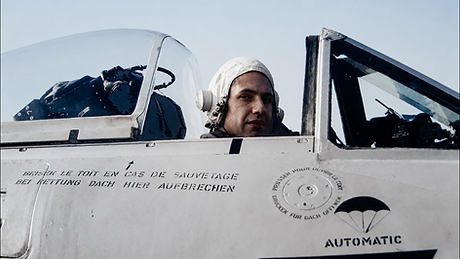
The exact date when the Stoffhaube (“cloth hood”) was first introduced into service is rather unclear; we have no documentation on the matter, and the earliest dated picture we are aware of was taken in 1955 during and open day at the Dübendorf AFB.
It can be assumed that the idea of developing a lightweight cloth helmet dates to the period when the DH-100 was introduced, as its pilots were equipped with British C-Type leather helmets. It is possible that their request for a “lightweight helmet version” in order to cope with the heat under the canopy was made during that same period.

The Swiss Air Force developed a summer flying helmet known as the Stoffhaube or less used Funkhaube.
The Stoffhaube combined maximum ventilation with the communications and oxygen-mask compatibility required for military operations. Although intended as a lightweight alternative to the standard various leather flying helmet in service, it incorporated several distinctive features that reflected the specific operational requirements of the Swiss Air Force.
Its overall design was loosely based on the British C-Type flying helmet, while the extended rear neck flap was inspired by the tropical D-Type, providing improved protection from direct sunlight during summer flying.
The helmet was assigned the designation P.A. (Piloten Ausrüstung – Pilot Equipment) 481.
During the second half of the 1950s, as ejection seats entered widespread Swiss Air Force service, the Stoffhaube was progressively replaced by hard-shell protective helmets offering substantially improved impact protection during ejection.
The Stoffhaube was manufactured from lightweight white cotton and deliberately left unlined to maximise ventilation and minimise heat retention.
The chinstrap and the two-rear goggle-retaining straps were made from soft white leather. Each was secured by buttons on one side and adjusted by means of a buckle on the opposite side.


A two-position adjustable nape strap, maintained under constant tension by two springs, was routed through a dedicated fabric pocket at the rear of the helmet, ensuring a secure yet comfortable fit during flight.

If required, the oxygen mask was secured by means of snap fasteners positioned on the left-hand side of the helmet and a hook fitted to the right-hand side, allowing rapid adjustment while maintaining a secure fit during flight.
There were four fasteners on each side.

Another snap fastener positioned on the lower left side was probably intended to retain and correctly position the communication cable, in much the same way as on the C-Type helmet.
Some surviving Stoffhauben feature an additional snap fastener positioned further aft; however, no documentation has yet been found explaining the reason for this variation.
Likewise, we are not aware of any photographic evidence showing that any of these additional fasteners were actually used during operational service.

Interestingly, this attachment philosophy was later carried over to the early Swiss-modified H-5 helmets.
The distinctive left-hand leather tab adopted for the H-5 retained an almost identical arrangement, differing principally in the number of oxygen-mask attachment fasteners (3). This continuity illustrates the evolutionary approach adopted by the Swiss Air Force when developing successive generations of pilot equipment.
The oxygen-mask microphone—or, when oxygen equipment was not required, throat microphone—was connected to the helmet through a two-pole JJ-048 / ELNO JK 048 FR jack located below the pilot's left earpiece.

The Stoffhaube was worn with various types of oxygen masks.
Pilots could be provided with British H-Type or the American A-14 oxygen masks, the latter, if required, modified by adding the same dilution valve fitted to the H-Type mask.
This modification was necessary to ensure compatibility with the oxygen-economizer system installed in the Vampire and other aircraft fleets.
More HERE


Among the other oxygen masks used with the Stoffhaube was the A-13A / MS22001.
Depending on the aircraft type, this could be paired with the standard corrugated oxygen hose, or with the Swiss “Röhrli” (“small hose”, in Swiss German dialect) breathing hose, used on aircraft such as the Pilatus P-2, PC-6 Porter and the F+W C-36.
More HERE
More HERE

The Stoffhaube was fitted with 10A/13466 earphones as the ones installed in C-Type helmets. These were secured inside chamois-covered 10A/13430 headset cushions, that came in either cream or grey colour.


Each earphone was sewn into a dedicated helmet’s fabric ear pocket, while the cloth-covered communication harness exited the rear of the helmet through a fabric tunnel positioned above the neck.
Either depending upon the aircraft communication system, the helmet could be equipped with a Type 671 NATO (UK/European) connector or the earlier six-pin MAAG Stecker, both of which remained in Swiss Air Force service during the period.


The utilization of a boom-mounted mike was not foreseen; if the oxygen mask was not being used, one of the various version of US T-30, British TMC (Telephone Manufacturing Company) Tc26216 or ELNO LY-1-A throat microphones were used.
(The origin of the ELNO brand would find the beginning of its acronym “EL” in the Etablissement Lailler-Pecquet and the “NO” would come from the name of the Swedish diplomat Raoul Nordling, one of the founding shareholders of the company)
Despite the introduction of hard helmets, period pictures demonstrate that the Stoffhaube continued to be used on aircraft equipped with ejection seats, as the DH-100 after being modified with their installation.
The reasons for this remain uncertain. Pilot preference and the superior comfort of the lightweight cloth helmet are plausible explanations, although no documentary evidence has yet been found to confirm this.


This picture taken in 1956, shows a DH-115 Mk.55 Vampire Trainer crew preparing for an instrument training flight. This interpretation is supported by the amber-coloured film applied to the canopy, a feature associated with IFR training.
Interestingly, the pilots are provided with different masks: an H-Type and a modified A-14. Although difficult to discern, the pilot in the background is possibly wearing a laryngophone.
During these flights, the trainee was wearing Polaroid M-1944, B-8, or USN 1-F-4B flying goggles fitted with blue plastic lenses. These special training lenses, in combination with the orange canopy film, prevented the pilot from seeing outside the cockpit while still allowing clear visibility of the flight instruments, thereby simulating instrument meteorological conditions during visual condition flight.
The Stoffhaube was in use for a long time; It still appears in the 1994 pilots’ equipment catalogue; we do not know exactly when it was decommissioned.
In this photo taken in 1976, the crew is aboard an Aero Commander aircraft used to take aerial photographs from which national maps were produced. The aircraft was operated by the Swiss Air Force on behalf of the Federal Office of Topography (Swisstopo).
